Understanding Public & Private Markets
The beginner level understanding of public vs.private markets


The public & private markets can be tough to understand. The more research you do, the more rabbit holes you fall into. Understanding each takes years, and even the best in the game have failed to make substantial profits from time to time.
Let’s understand the public markets at first:
Public Markets
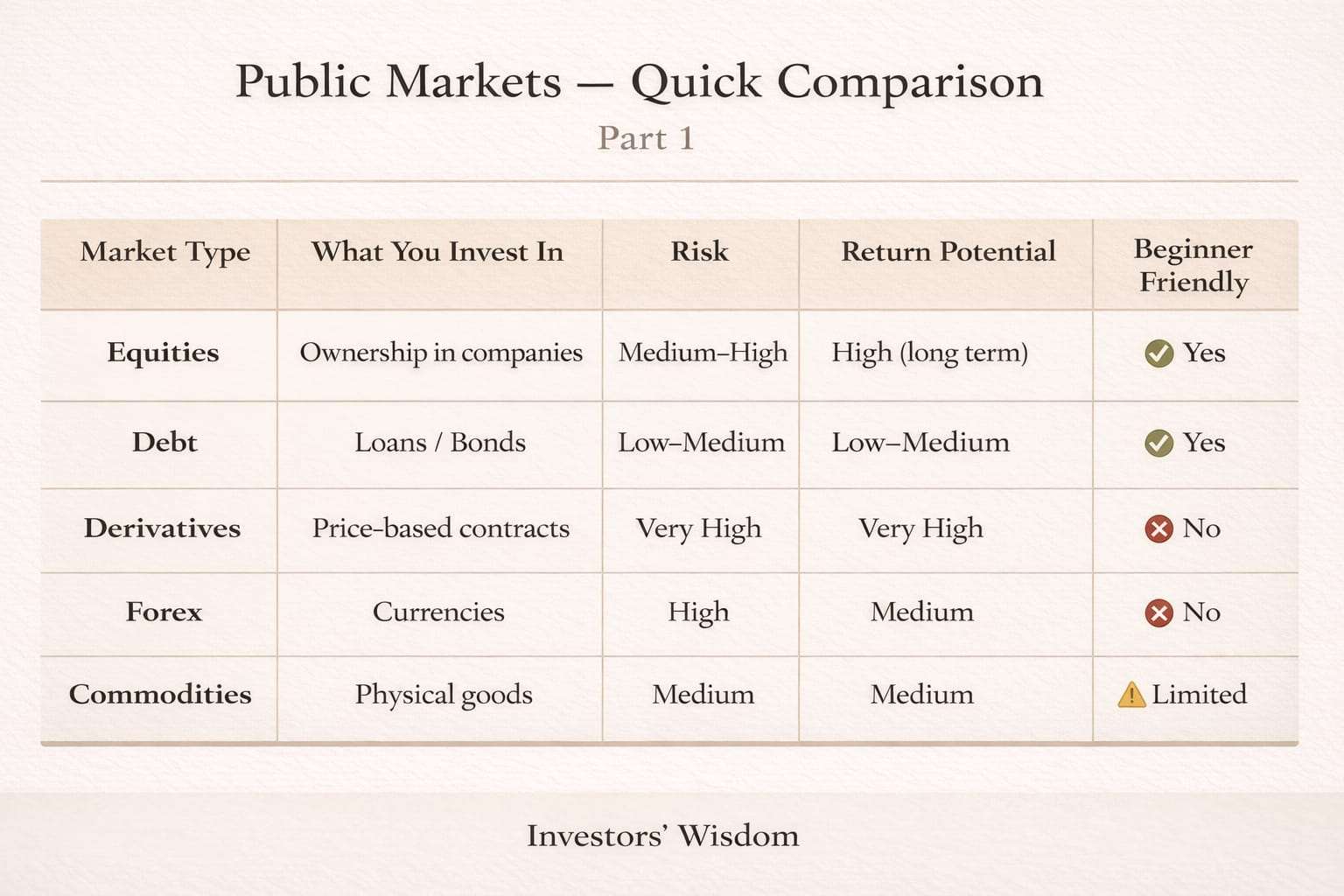
Public markets offer investors access to five main asset classes, each with distinct characteristics and risk profiles
Let’s go through each class:
1.Equity
When you use a brokerage account and start buying stock, you officially own a set equity in the company you are buying. This asset class carries medium to high risk because stock prices fluctuate based on so many factors, such as company performance, quarterly earnings, political changes, tariffs, and many more. Although they are risky, they offer the highest long-term returns, making them essential for wealth building.
2.Debt Investments
A common example of debt investments is a bond, a loan you provide to corporations or governments in exchange for regular interest payments and the return of your principal at maturity. These carry low to medium risk since you're contractually owed payments, making them more predictable than stocks. Debt investments provide stability and income to portfolios, serving as a counterbalance to the volatility of equities.
3.Derivatives
Derivatives are price-based contracts that derive their value from assets like stocks, commodities, or currencies. The most common types of derivatives include options and futures. These instruments carrya very high risk because they often involve leverage, meaning small price movements can result in large gains or devastating losses. Derivatives are primarily used by experienced investors for hedging risk or speculation, and beginners should avoid them until they have substantial market knowledge.
4.Forex
Forex involves trading currencies against each other, such as exchanging US dollars for euros based on exchange rate movements. This market carries high risk due to extreme volatility, leverage, and the complex factors that drive currency values, including interest rates, geopolitical events, and economic data. While forex is the largest financial market in the world, its complexity and risk make it unsuitable for most beginning investors.
5.Commodities
Investments in physical goods like gold, oil, agricultural products, or industrial metals. These carry medium risk and often move differently from stocks and bonds, providing diversification benefits during inflation or economic uncertainty. Investors typically access commodities through specialized funds, ETFs, or futures contracts rather than holding the physical goods themselves.
Private Markets
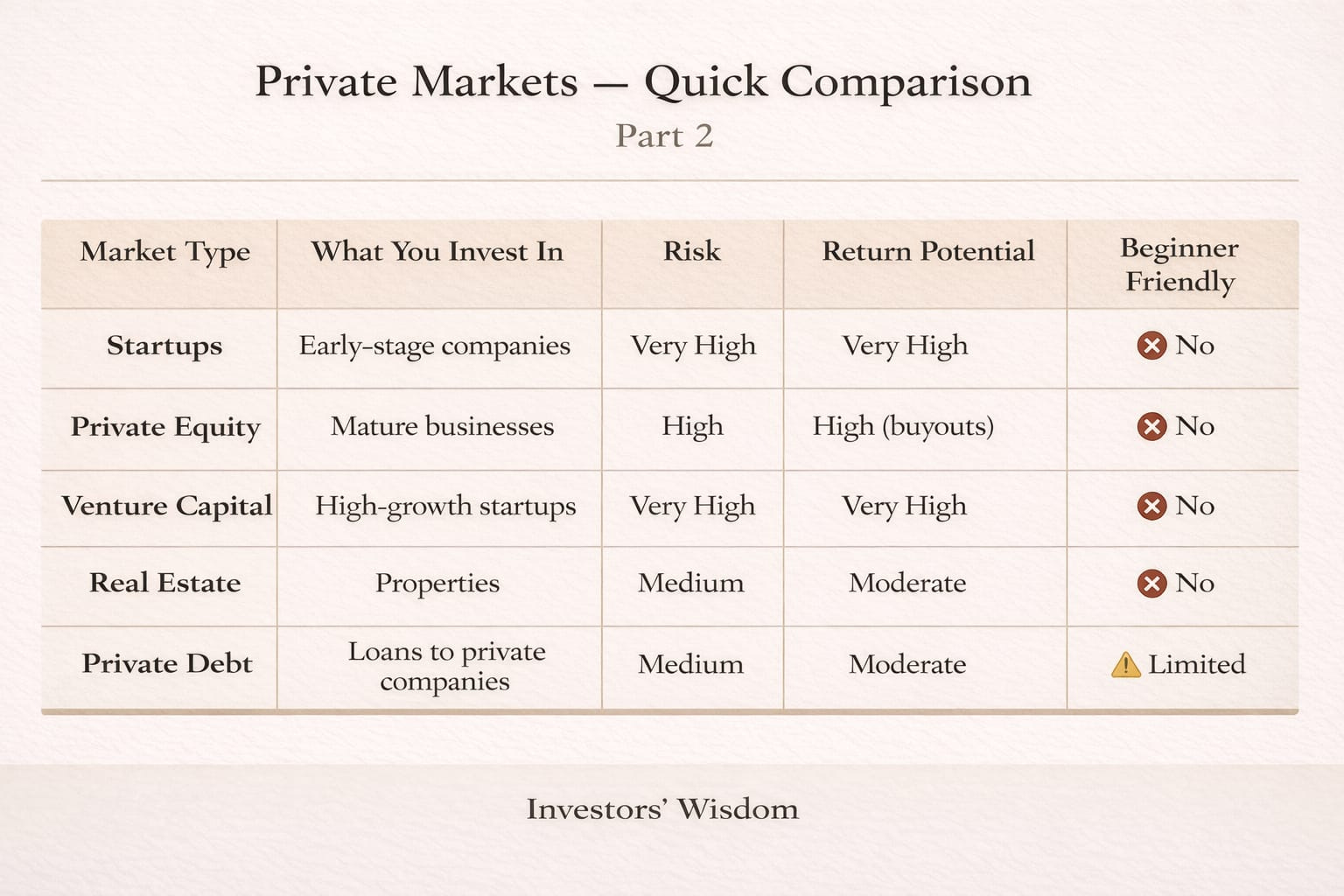
Private markets are much more inclusive and harder to understand since they are not something a lot of people focus on or talk about. There are 5 common ones, which are:
1.Private Equity
This is the hallmark of the private markets. They involve purchasing ownership stakes in private companies or taking public companies private, typically through leveraged buyouts, growth investments, or venture capital deals. These investments carry high risk but offer the potential for substantial returns as firms actively work to improve operations and grow the business over a 3-7 year holding period. Private equity requires patience and long-term commitment, as your capital is locked up and illiquid until the company is sold or goes public. Common examples are Blackstone, KKR, Thoma Bravo, and many more.
2.Private Credit/Debit
Consists of non-bank lending directly to private companies through loans, mezzanine financing, or distressed debt investments. This asset class typically offers medium-high risk with more predictable income streams than equity, as lenders receive regular interest payments and often hold senior positions in the capital structure with collateral protections. Private credit has grown rapidly as an alternative to traditional bank lending, providing investors with attractive yields in exchange for accepting illiquidity.
3.Real Estate
Real Estate encompasses direct investments in physical properties ranging from apartments and office buildings to warehouses and shopping centers, typically accessed through private funds or REITs. This asset class carries medium risk and offers both potential appreciation and regular income through rent payments, while also serving as a potential inflation hedge. Real estate investments can provide diversification benefits since property values often move independently of stock and bond markets.
4.Venture Capital
A subset of priuvate Equity but investing in early-stage companies from their formation and beyond. This asset class carries very high risk; most startups fail, but successful investments can generate outsized returns that compensate for the losses (power rule). Venture capital requires specialized expertise to evaluate unproven business models and patience to wait 7-10+ years for exits through acquisitions or IPOs.
5.Infrastructure
Involves investments in essential physical assets that underpin society and the economy, such as toll roads, airports, power plants, cell towers, and water systems. These investments typically offer medium-low risk with stable, inflation-protected cash flows since infrastructure services remain in demand regardless of economic conditions. Infrastructure appeals to long-term investors seeking predictable income and exposure to transformative trends like renewable energy and digital connectivity.
 | A guest post by
|
Great to collab sathvik !
Hi! A much needed refresher to understand the different asset classes in public vs private markets. I write on LegalTech startups analyzing investment opportunities in the space. Would love to get your thoughts on my latest post!
https://harshithviswanath.substack.com/p/three-legaltech-whitespace-plays?r=4y4gfu